


GLOBAL OCEAN
North Atlantic
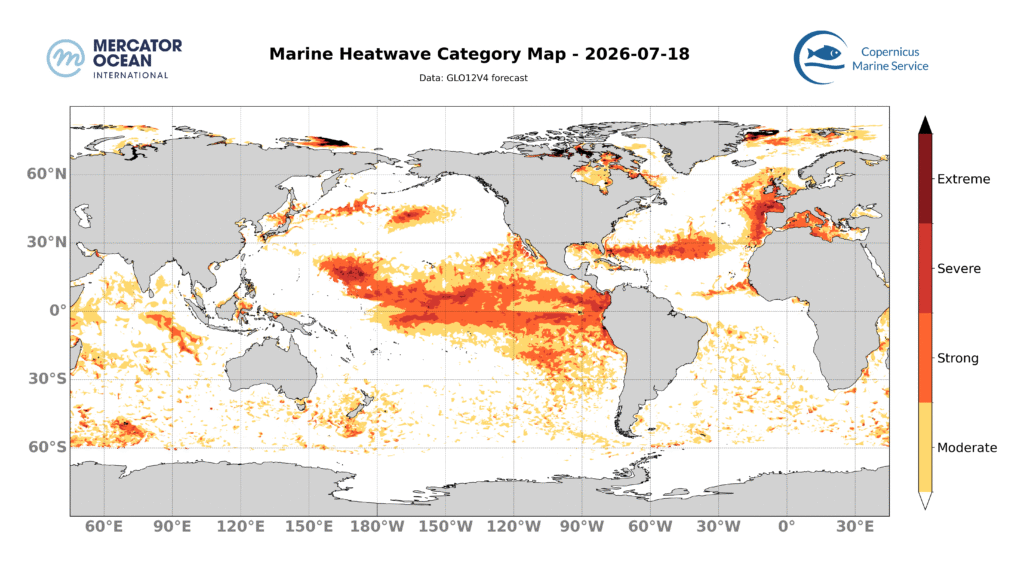
A marine heatwave spanning approximately 10° of latitude stretches from the coast of Florida to the central Atlantic around 30°W. Its intensity is increasing, with mostly strong and locally severe conditions. The marine heatwave in the Gulf of Mexico is decreasing in both intensity and area; a few moderate and strong categories remain in the northern Gulf.
Pacific Ocean
The marine heatwave in the southern Bering Sea is decreasing in area but increasing in intensity, with an equal number of strong and moderate categories. The marine heatwave in the Sea of Japan is decreasing in both area and intensity. The marine heatwave extending across nearly the entire equatorial band from 15°S to 20°N is increasing in both area and intensity. Strong to severe categories persist off the coast of Central America and also extend around 15°N between 140° and 180°W longitude, with a few patches of extreme category in this area. The heatwave between 90°W and 120°W is stable in area but is increasing in intensity, with more strong categories. It is tending to form a relatively homogeneous system with the one present in the equatorial band. The marine heatwaves in the inland seas of the Philippines are decreasing in both area and intensity. The marine heatwave south of New Zealand remains stable in both intensity and area.
Indian Ocean
The marine heatwave in the northeastern part of the basin, near the Cocos Islands, remains generally stable in terms of coverage but is increasing in intensity locally, with a mix of moderate and strong conditions.
Southern Ocean
The marine heatwave, extending from 50°E to 80°E in longitude and 45°S to 60°S in latitude, remains stable in both area and intensity, with conditions still ranging from moderate to strong.
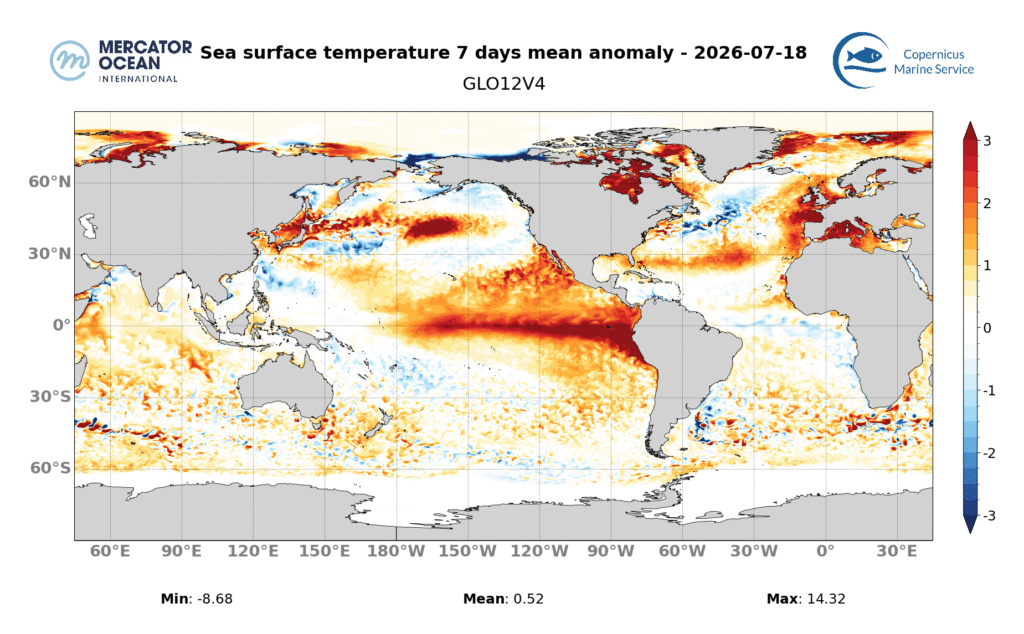
| Mediterranean Sea | 0°C to >3°C |
| North Atlantic | -3 °C to >3°C |
| North Pacific | -2°C to >3°C |
| South Pacific | -1°C to >3°C |
| Southern Ocean | -1°C to 1.5°C |