


GLOBAL OCEAN
North Atlantic
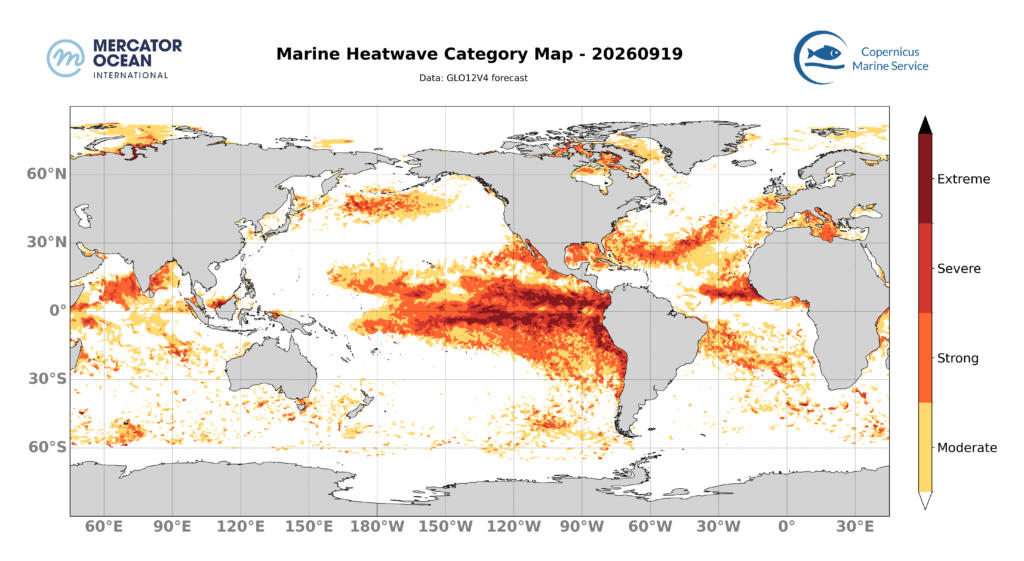
From the Azores to the coasts of Florida and the Caribbean, the marine heatwave remains stable in area but is increasing in intensity, with numerous areas in the strong category.
The marine heatwave off the coast of Guinea is increasing in intensity toward the west, with strong and severe categories, and even extreme conditions locally. Its area remains generally stable.
The marine heatwave in the Gulf of Mexico is stable in area, and its intensity is decreasing; however, strong categories remain predominant.
South Atlantic
The marine heatwave stretching from Brazil to South Africa remains generally stable in terms of both area and intensity.
Pacific Ocean
The marine heatwave, which extends across nearly the entire equatorial belt from 30°S to 25°N, remains generally stable in terms of coverage but is increasing in intensity; moderate categories are in the minority, while strong categories are becoming predominant and are spreading toward the central-western equator as well as across a broad band along the coasts of California and Mexico. There are also numerous areas classified as extreme from the coasts of Latin America to 150°W.
A few scattered areas of moderate marine heatwaves persist west and south of New Zealand, though their coverage is decreasing. A moderate-to-strong marine heatwave is present around Tasmania.
The marine heatwave south of the Bering Sea (around 50°N) is increasing in intensity and area, with strong categories in the west and moderate categories toward the east.
Indian Ocean
Marine heatwaves in the central Indian Ocean and east of Madagascar are shrinking in area. The one in the Arabian Sea remains stable in area but has been downgraded from “extreme” to “strong.” The one in the Bay of Bengal, east of India, is expanding and is now classified as “moderate” to “strong.”
Weekly temperature anomalies
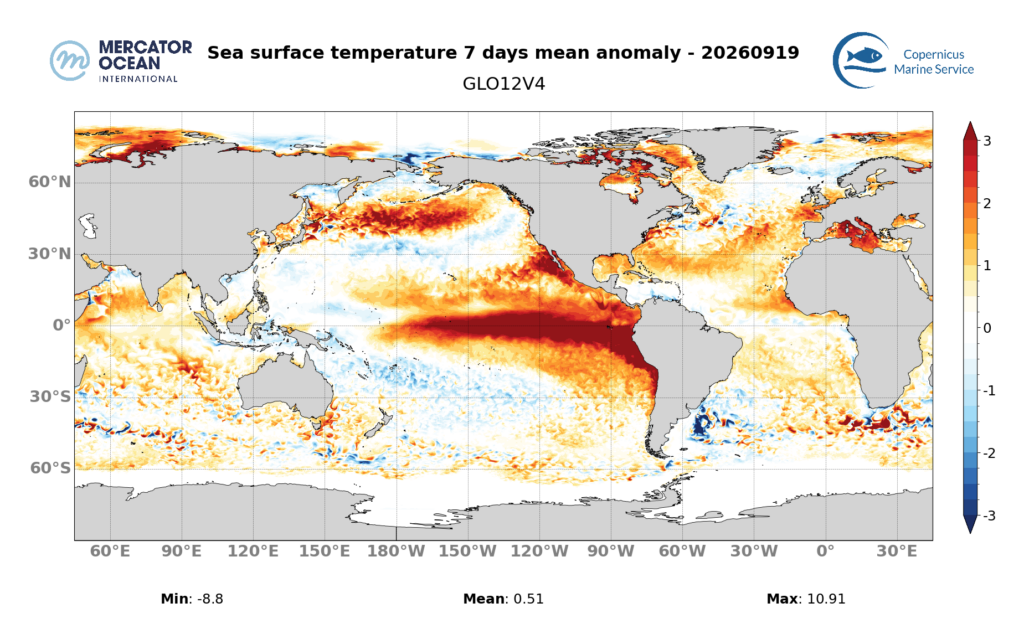
| Mediterranean Sea | 0°C to >3°C |
| North Atlantic | -2 °C to 3°C |
| Pacific Ocean | -2°C to >3°C |
| Indian Ocean | -1°C to 2°C |
| South Atlantic | -3°C to 3°C |