


Global Ocean
North Atlantic
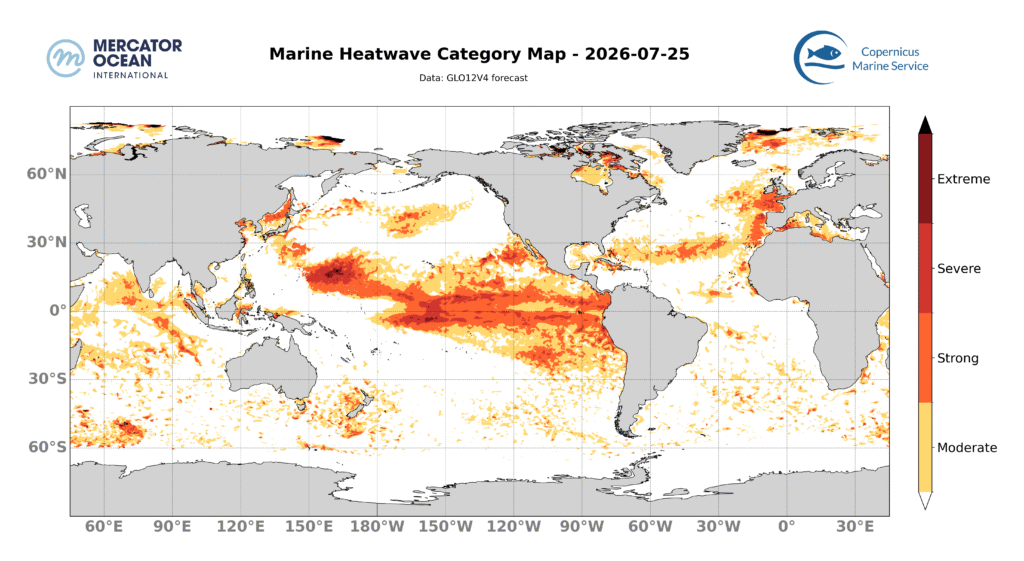
The marine heatwave extending from south of the British Isles and stretching across the Atlantic all the way to Florida, generally stable in area but is decreasing in intensity, with most areas now classified as moderate to strong. The marine heatwave in the Gulf of Mexico remains stable in intensity, with most areas still classified as moderate, but is decreasing in extent.
Pacific Ocean
North : The marine heatwave in the southern Bering Sea (around 50°N) is expanding in extent but remains stable in intensity, with conditions still ranging from moderate to strong. The marine heatwave in the Sea of Japan is increasing in intensity and is now mostly in the strong category.
Equatorial: The marine heatwave extending across nearly the entire equatorial axis from 30°S to 30°N remains generally stable in both area and intensity, with conditions still ranging from moderate to severe and locally extreme, except for the western part of this marine heatwave (from 180°E to 1550°E), which is increasing in intensity and is mostly moving into the strong to severe category, with locally extreme conditions.
South : The marine heatwave south of New Zealand remains stable in both intensity and extent.
Indian Ocean
Marine heatwaves in the basin (west of Madagascar, in the Arabian Sea, and in the central part of the basin) remain generally stable in terms of extent and intensity, with conditions still ranging from moderate to strong.
Southern Ocean
The marine heatwave, extending from 50°E to 80°E in longitude and 45°S to 60°S in latitude, remains stable in both area and intensity, with conditions still ranging from moderate to strong.
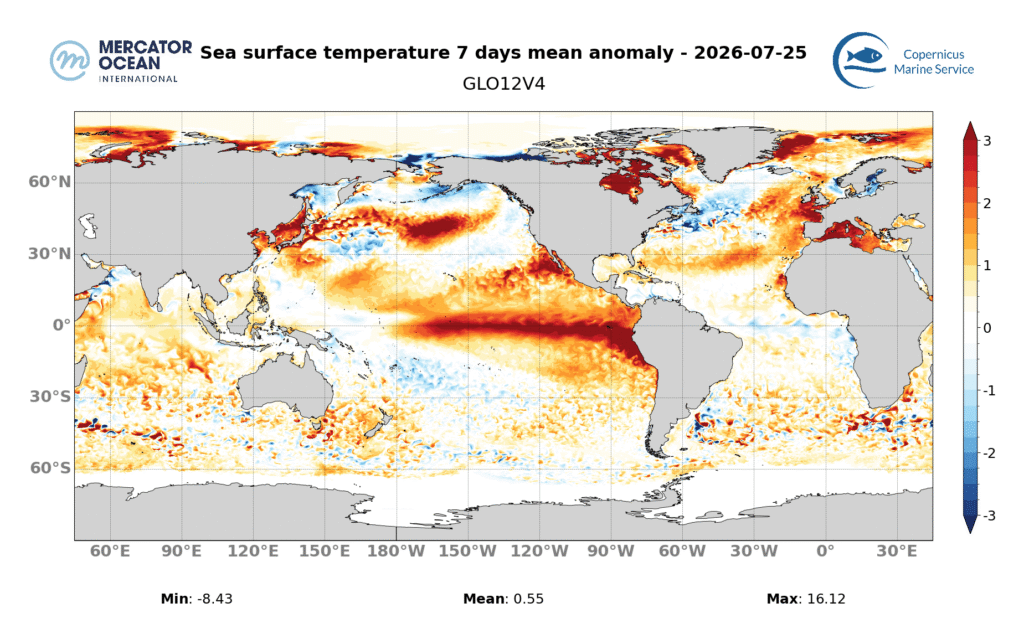
| Mediterranean Sea | 0°C to >3°C |
| North Atlantic | -3 °C to >3°C |
| Pacific Ocean | -2°C to >3°C |
| Indian Ocean | -2°C to 2°C |
| Southern Ocean | -1°C to 2°C |