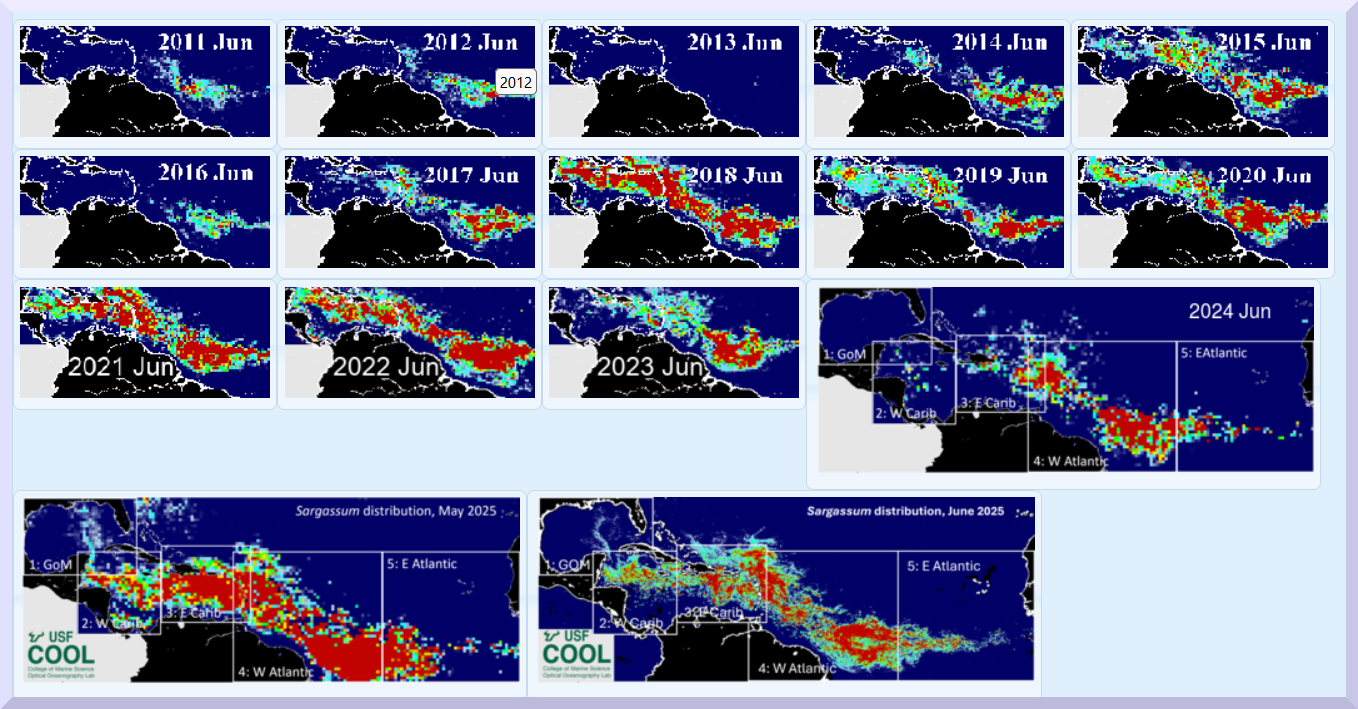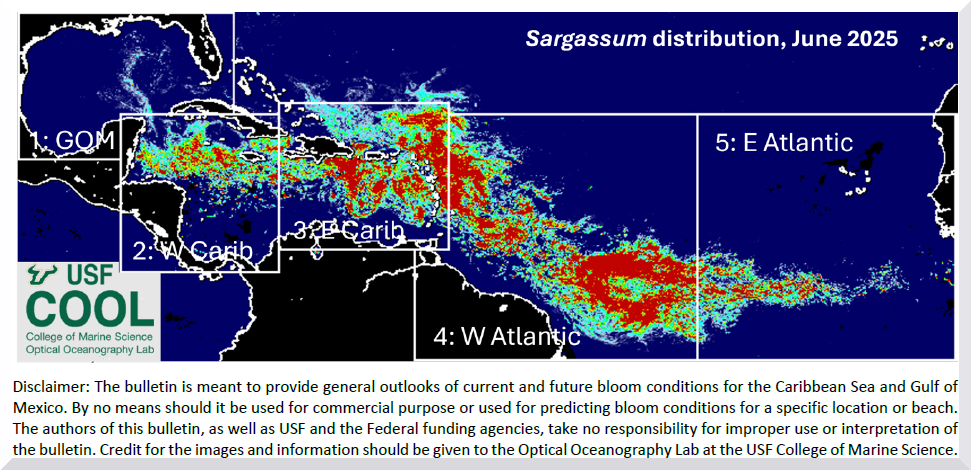
The map shows average Sargassum abundance for the month of June 2025, with warm colors representing higher abundance. The top color (red) indicates that 0.4% of the ocean surface is covered by Sargassum, meaning that Sargassum clumps and mats are scattered here and there in the location. The Sargassum abundance for each region is compared with historical values in the same month of 2011 – 2024 in the whisker box plot below, where horizontal bars in each vertical box indicate minimum, 25%, 50%, 75%, and maximal historical values, respectively.
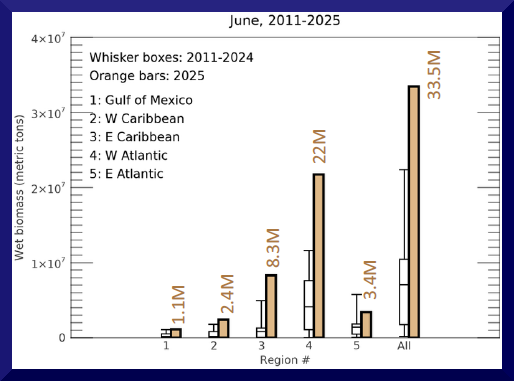
As predicted in the last bulletin, total Sargassum amount in 3 of the 5 regions continued to increase in June. These are the Gulf of America, western Caribbean, and eastern Caribbean. In contrast, total Sargassum amount decreased slightly in the central West Atlantic, and dropped substantially in the East Atlantic. Such a disparity indicates that most increases in the first 3 regions were due to physical transport, while Sargassum growth in the tropical Atlantic lost momentum. Nevertheless, most regions still reached their historical highs. On the other hand, the spatial distribution patterns in June remained stable from May. Significant Sargassum inundation events have continuously been reported around most Caribbean nations and islands, including the Mexican Caribbean coast. Small amount of Sargassum continued to reach the Straits of Florida.
Looking ahead: June 2025 appears to be the month of a turning point for the tropical Atlantic, after which the total Sargassum amount will decline although the absolute amount will continue to be high than most of previous years. The amount in the Caribbean Sea may remain stable as local decrease may be compensated by physical transport. More Sargassum is expected to be transported to the Gulf through the Yucatan. Sargassum inundation of variable degree will continue to occur in most of the Caribbean nations and islands as well as along the southeast coast of Florida. However, whether a beach or small region receives large amount of Sargassum depends on local factors that are difficult to predict, including winds and ocean currents.
All previous monthly bulletins as well as daily imagery can be found under the Sargassum Watch System (SaWS).