


A perspective for the Caribbean Sea and Gulf of America* by the University of South Florida Optical Oceanography Lab – (bbarnes4@usf.edu, yuyuan@usf.edu, huc@usf.edu)
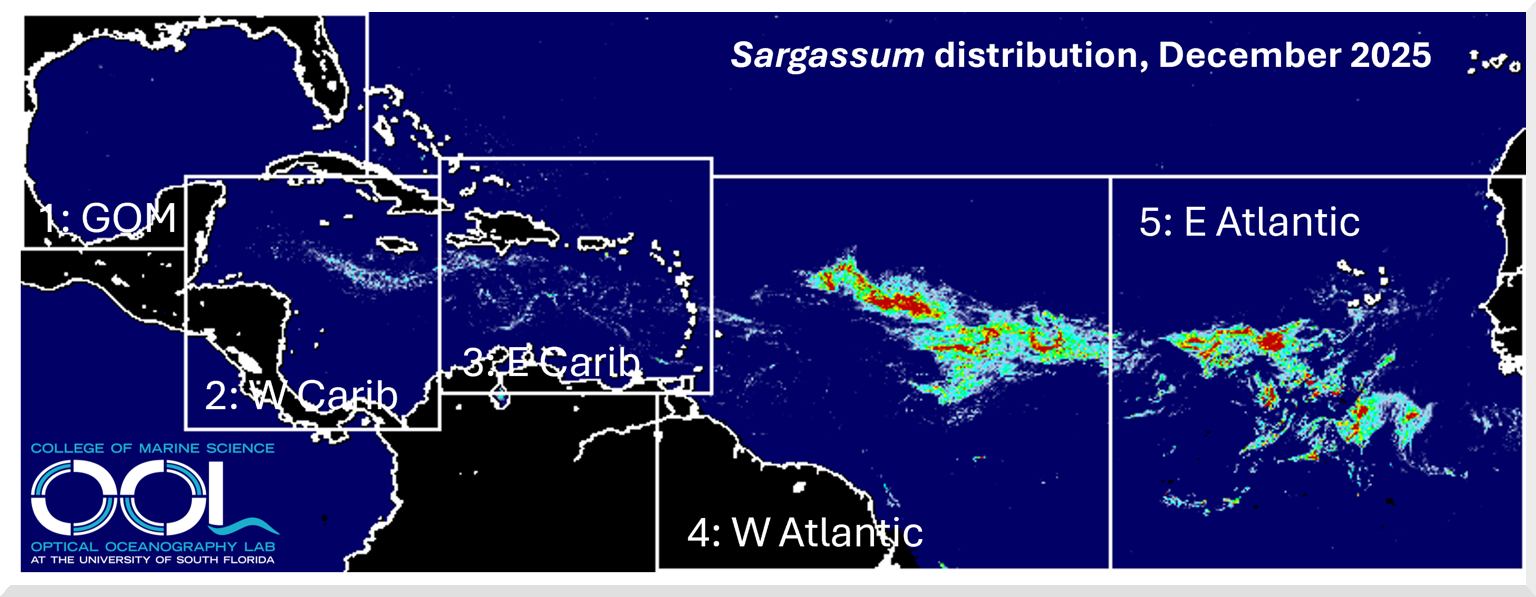
The map above shows the average Sargassum abundance for the month of December 2025, with warm colors representing higher abundance. The top color (red) indicates that 0.4% of the ocean surface is covered by Sargassum, meaning that Sargassum clumps and mats are scattered here and there in the location. The Sargassum abundance for each region is compared with historical values in the same month of 2011 – 2024 in the whisker box plot below, where horizontal bars in each vertical box indicate minimum, 25%, 50%, 75%, and maximal historical values, respectively.
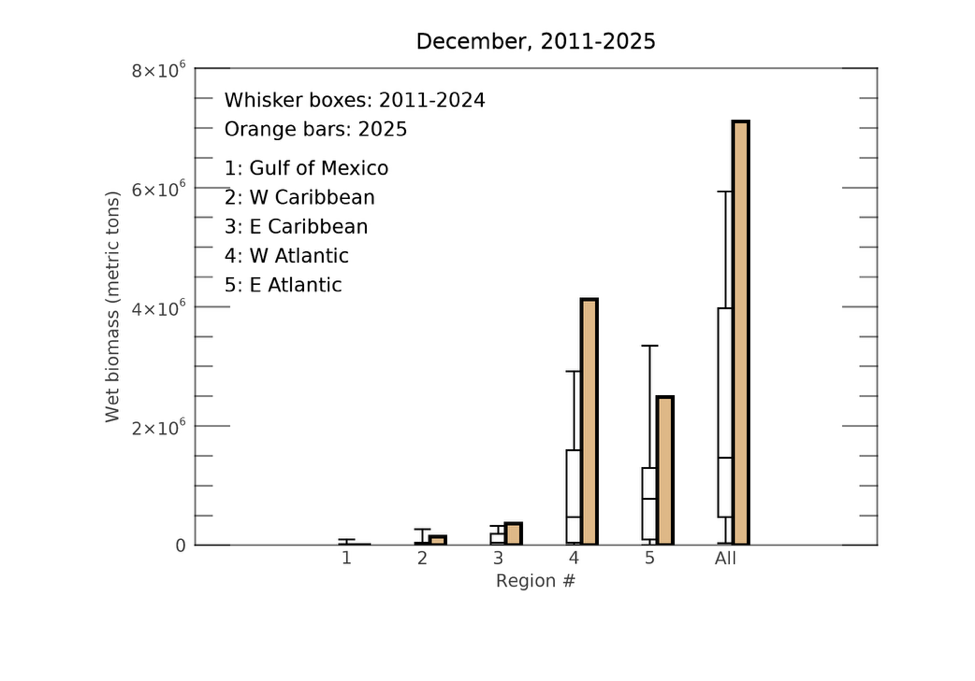
Compared to November 2025, substantially increased Sargassum amount was found in every region except the Gulf. In particular, the sharp increases in the E Caribbean Sea and W Atlantic led to record-high Sargassum in December. The W Caribbean Sea also saw rapid increases although the absolute amount was still low. The most striking result is, as shown in the map below, there are two separated large masses in the W and E Atlantic, respectively, both due to local growth and contributing to the record-high Sargassum amount in December for the entire Atlantic.
Looking ahead: Although Sargassum amount in the Gulf will remain negligible, Sargassum in the Caribbean will likely continue to grow, leading to beaching events along the Mexican Caribbean coast and some of the Lesser Antilles islands. Some beaching events may already have occurred. Such early beaching events are unusual, but will likely continue in the coming months. Because of the rapid growth from November to December and because of the high Sargassum amount in most regions, 2026 is likely another major Sargassum year (i.e., Sargassum amount exceeds 75% of the historical values).
All previous monthly bulletins as well as daily imagery can be found under the Sargassum Watch System (SaWS). Meanwhile, we will keep a close eye on Sargassum changes in all regions.